
Guide To Vietnam’s Pre-Arrival Form 2026 (72 Hours Before Arrival)

Planning a trip to Vietnam? Before packing your bags, take a few minutes to check the latest entry requirements and prepare the documents you may need at the airport.
Vietnam’s Pre-Arrival Information (PAI) system allows international travellers to submit selected personal, visa and travel details online before arriving in the country. After a successful submission, the system generates a QR code that travellers can save on their phones or print for use during immigration procedures. Although the online declaration is designed to help make arrival procedures smoother, travellers should understand when it applies, how to complete it correctly and which documents they still need to enter Vietnam.
In this practical guide, you will discover where to access the official PAI portal, what information to prepare, how to complete the declaration step by step, how to correct common mistakes and what to do when you arrive at the airport.
Table of Contents
- I. What Is Vietnam’s Pre-Arrival Information (PAI) Form?
- II. Is the Vietnam PAI Form Mandatory?
- III. Where Can You Complete the Vietnam PAI Form?
- IV. When Should You Complete the PAI Form?
- V. What Information Should You Prepare?
- VI. How to Complete the Vietnam PAI Form Step by Step
- 1. Step 1: Open the official PAI portal
- 2. Step 2: Select your preferred language
- 3. Step 3: Select “Create & Submit Pre-arrival Information”
- 4. Step 4: Enter your personal information
- 5. Step 5: Complete the visa and travel sections
- 6. Step 6: Review the declaration before submitting
- 7. Step 7: Submit the form and save your QR code
- VII. What Should You Do If the PAI Form Does Not Work?
- VIII. What Happens When You Arrive at a Vietnamese Airport?
- IX. Does the PAI Form Replace a Vietnam Visa?
- X. Practical Tips for Families, Groups and Connecting Flights
- XI. Frequently Asked Questions About Vietnam’s PAI Form
I. What Is Vietnam’s Pre-Arrival Information (PAI) Form?

The Pre-Arrival Information system is an online service operated by Vietnam’s Immigration Department under the Ministry of Public Security. It enables foreign visitors to provide certain travel and immigration information before entering Vietnam.
The purpose is to help immigration authorities prepare for travellers’ arrival, support the digitalisation of entry procedures and potentially reduce waiting times at immigration checkpoints.
The process is straightforward:
Access the official PAI website.
Select your preferred language.
Start a new declaration and complete the verification step.
Enter the requested personal, visa and travel information.
Submit the declaration and save the QR code generated by the system.
The QR code is intended to facilitate the arrival process. However, completing the form does not guarantee admission to Vietnam, and travellers must still comply with all applicable immigration requirements.
II. Is the Vietnam PAI Form Mandatory?
As of October 2026, official information published by Vietnamese diplomatic authorities describes the PAI system as a voluntary, non-mandatory declaration for foreign visitors at five international airports:
Tan Son Nhat International Airport (SGN), Ho Chi Minh City
Noi Bai International Airport (HAN), Hanoi
Da Nang International Airport (DAD)
Cam Ranh International Airport (CXR), serving the Nha Trang area
Phu Quoc International Airport (PQC)
The system is intended to make immigration processing more efficient, and travellers are encouraged to submit their information before arrival. Nevertheless, you should check the latest official instructions for your specific airport and travel date, as the implementation arrangements may evolve.
Do not confuse the PAI declaration with a visa requirement. Whether you need a visa depends on your nationality, purpose of travel, length of stay and applicable Vietnamese entry rules. If you require an e-visa or another form of entry permission, you must obtain it separately.
Before departure, confirm three things:
Whether you need a visa or qualify for visa exemption.
Whether the PAI declaration applies to your arrival.
Whether your passport meets the validity and other conditions applicable to your journey.
III. Where Can You Complete the Vietnam PAI Form?
The official portal is: https://prearrival.immigration.gov.vn/
This is the website of Vietnam’s Immigration Department. It provides language options, including English and French, to help international travellers understand the declaration process.
For your safety, type the official address directly into your browser rather than clicking unfamiliar advertisements or sponsored links.
Is the PAI form free?
Use the official government portal and be cautious of third-party services asking you to pay to submit the declaration. Vietnamese authorities have warned about fraudulent websites impersonating the official PAI platform to obtain payment card details.
If a website asks for unnecessary payment information or promises guaranteed entry in exchange for a fee, stop and verify that you are using the correct government service.
IV. When Should You Complete the PAI Form?
Official guidance describes completing the declaration within the three days before arrival. If you intend to submit it, a practical approach is to prepare your documents in advance and complete the online process during the applicable window before you enter Vietnam.
For example, if your flight arrives on Friday, you can plan to complete the declaration during the three days leading up to your arrival, following the current instructions on the official portal.
Do not confuse the arrival date with your departure date. If you are travelling on a long-haul flight, use the date you are scheduled to enter Vietnam when following the declaration instructions.
For a journey involving several flights, check the details of the flight that actually arrives in Vietnam, rather than automatically using the first flight departing from your home country.
V. What Information Should You Prepare?
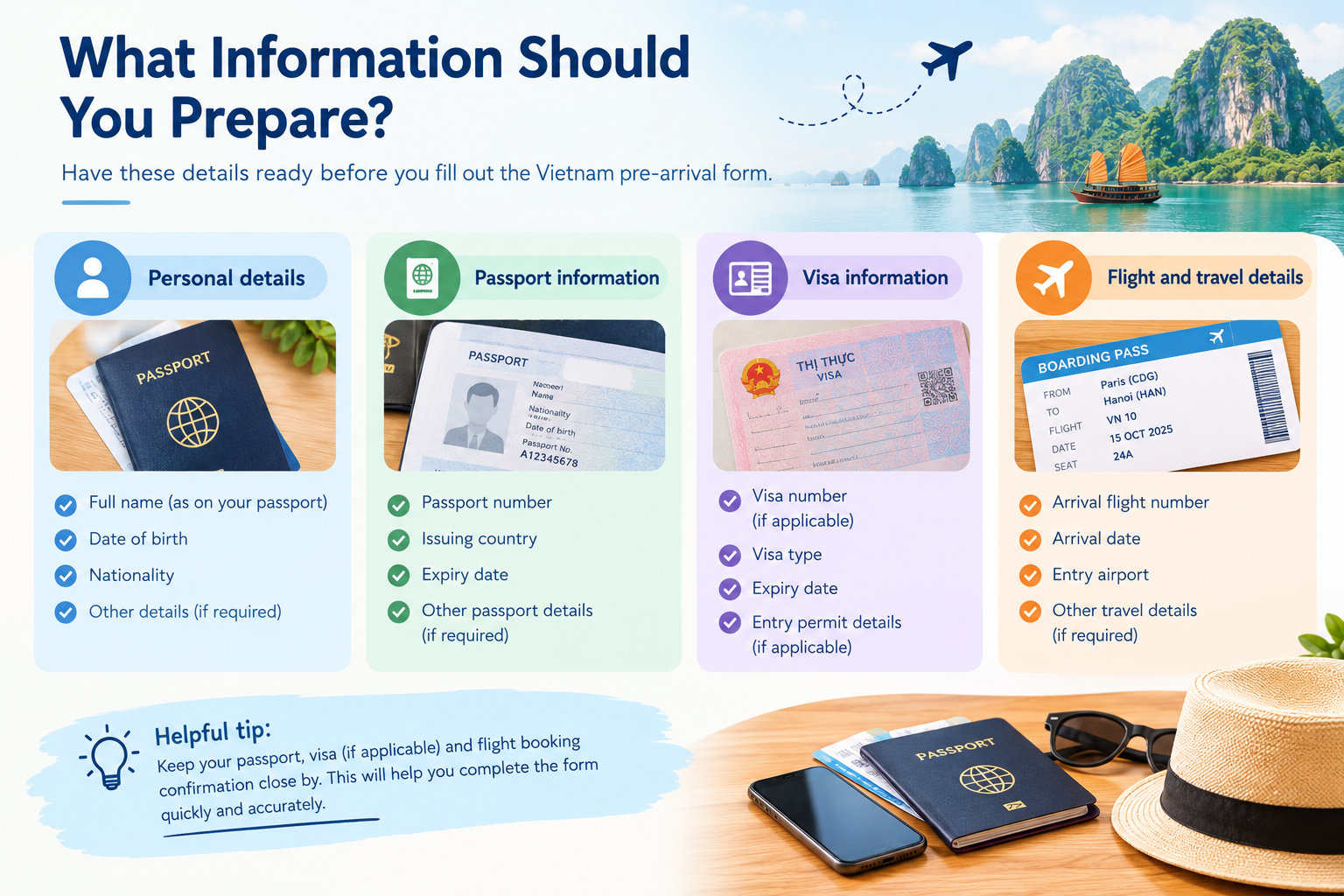
The exact fields displayed may depend on the portal’s current requirements. Vietnamese immigration guidance identifies three main categories: passenger information, visa information and travel information.
Preparing these details in advance can help you complete the form more accurately.
1. Personal and passport information
Keep your passport beside you while filling out the declaration.
You may be asked to provide details such as:
Full name as shown on your passport.
Passport number.
Nationality.
Date of birth or other identifying details requested by the system.
Passport-related information required by the form.
Important: Enter your name exactly as it appears in your passport’s biographical section. Do not substitute a nickname, shorten your given name or use a different spelling simply because it appears on another travel document.
If your passport contains several given names, follow the field instructions carefully. If a field is unclear, consult the portal’s guidance rather than guessing.
2. Visa and entry information
Prepare your Vietnamese visa or entry-permission details if applicable.
Depending on your circumstances, this may include information associated with your e-visa or other entry permission. Check that the information you enter matches the relevant document.
If you are travelling under a visa exemption, do not assume you need to invent a visa number or enter details from an unrelated document. Follow the options and instructions actually provided by the PAI portal.
Remember that the PAI declaration does not approve a visa. If you need a Vietnamese e-visa, use the official e-visa service and make sure your visa is valid for your intended entry date and conditions of stay.
3. Flight and travel information
This section deserves particular attention because an error in your flight details can prevent the information from matching the airline’s passenger records.
Before starting, check your booking confirmation for:
The airline and flight number of your arrival flight into Vietnam.
The scheduled arrival date.
The airport where you will enter Vietnam.
Any additional travel details requested by the portal.
Use the correct flight number. If you are flying from Paris to Hanoi via another city, for example, the relevant flight may be the final flight arriving in Hanoi rather than the first flight departing Paris.
If your itinerary includes a connecting flight, check which flight number corresponds to the leg entering Vietnam. Do not enter your booking reference or reservation number in a field asking for a flight number.
Vietnamese immigration authorities have reported unsuccessful declarations caused by passenger information, including flight numbers, not matching the available flight or booking data.
If the portal cannot validate your information, compare every field with your airline confirmation before submitting again.
4. Accommodation and onward travel details
Only enter accommodation or itinerary information if the portal requests it. Keep your first-night hotel address and onward travel details accessible in case they are needed for the form or other arrival procedures.
If you are staying at several hotels during your trip, do not automatically enter every accommodation address into a single field. Follow the specific instructions displayed on the portal.
VI. How to Complete the Vietnam PAI Form Step by Step
1. Step 1: Open the official PAI portal
Visit https://prearrival.immigration.gov.vn using a phone, tablet or computer with a stable internet connection.
Check the domain carefully before entering any personal information. The official portal belongs to Vietnam’s Immigration Department.
2. Step 2: Select your preferred language
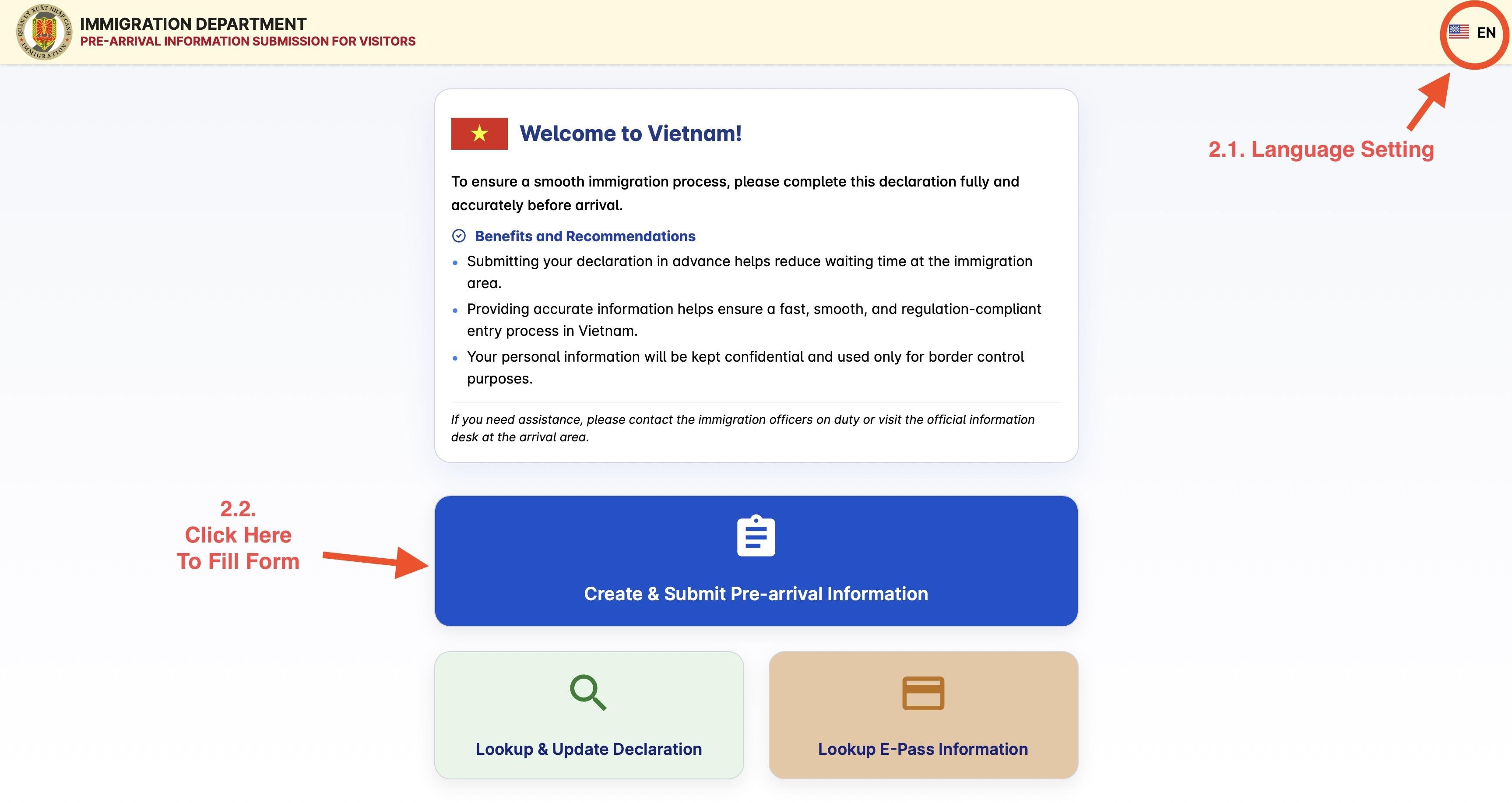
Choose English, French or another language available on the website.
Read the instructions before continuing. If you are helping a family member complete the form, make sure you understand whose details are being entered.
3. Step 3: Select "Create & Submit Pre-arrival Information"
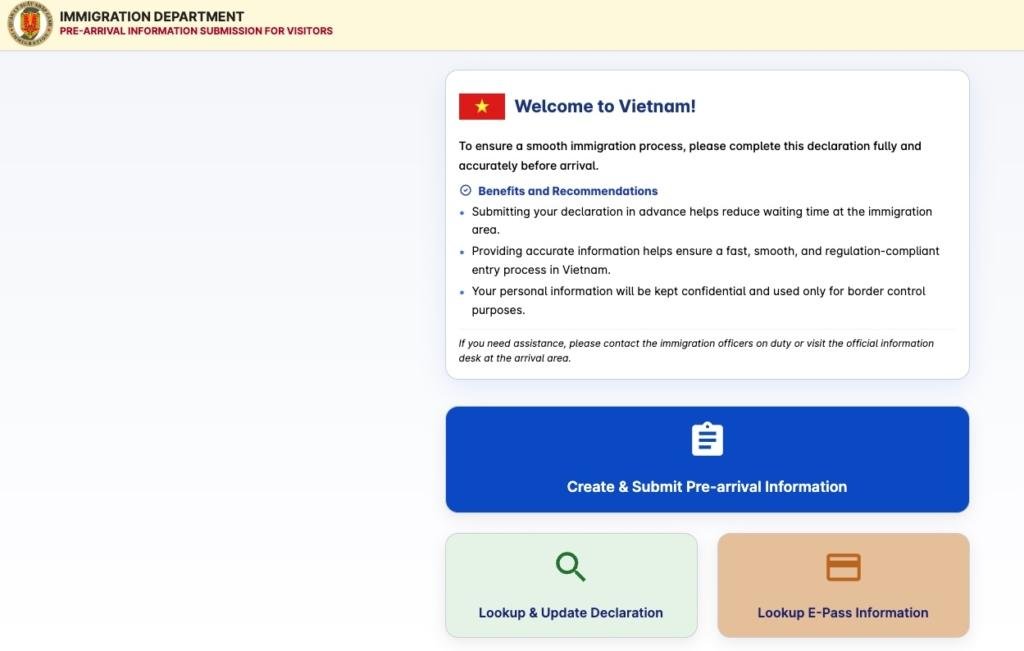
Choose the option to create and submit a new declaration.
The system may ask you to complete a CAPTCHA verification. This is a security check intended to distinguish human users from automated requests.
Enter the characters displayed on the screen. If they are difficult to read, use the refresh option if available.
4. Step 4: Enter your personal information
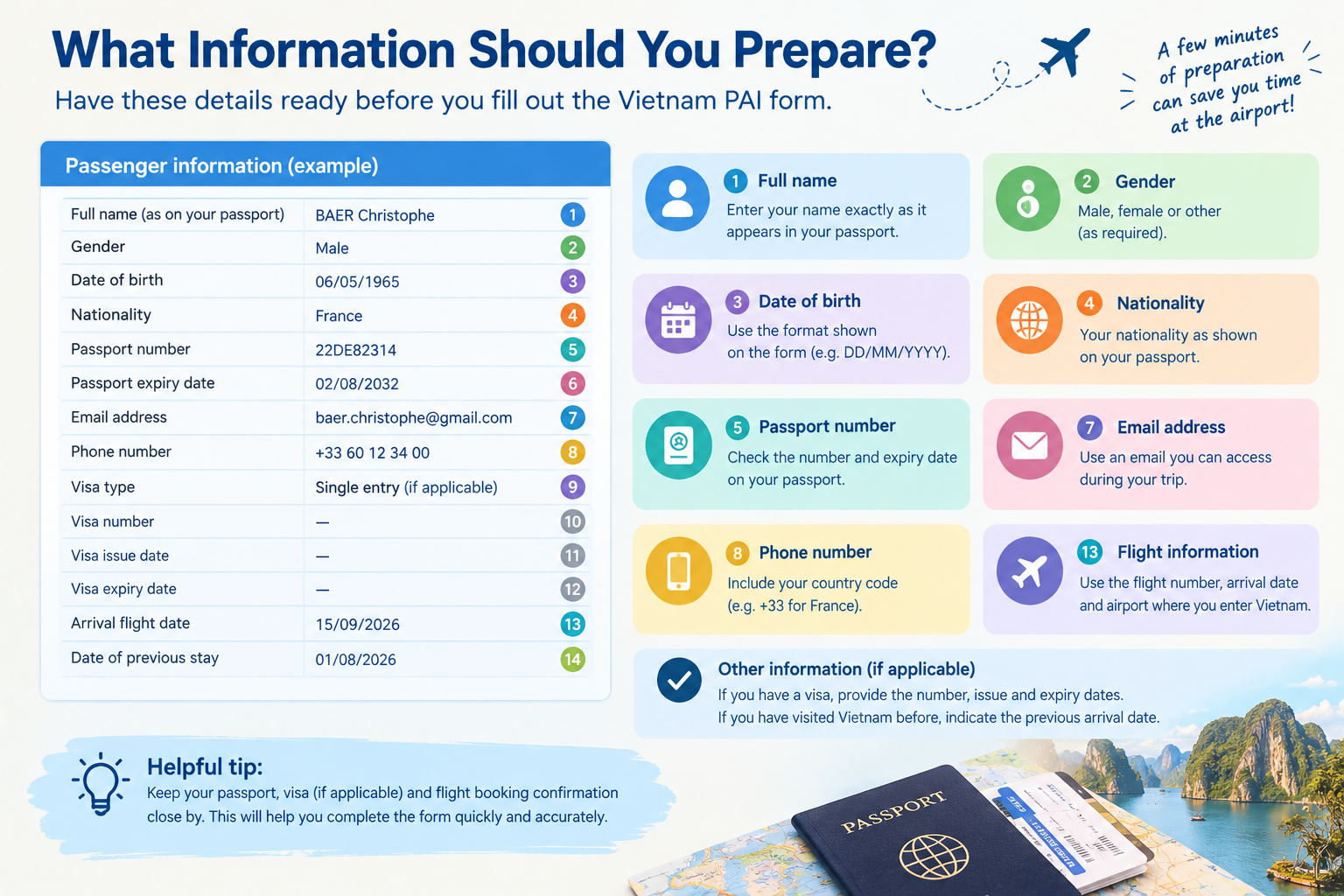
Complete the passenger information fields using your passport as the main reference.
Before continuing, check the spelling of your name, passport number, nationality and any other identifying details requested.
Avoid copying information from an old booking or a document that may contain outdated passport details.
5. Step 5: Complete the visa and travel sections
Follow the portal’s instructions to enter the relevant visa and travel information.
Pay particular attention to the arrival flight number and date. Compare these details with your latest confirmed itinerary, especially if your airline has changed your flight schedule.
If a field does not apply to your situation, use the available option or follow the portal’s instructions rather than entering a random value.
6. Step 6: Review the declaration before submitting
Before you submit, review the information from beginning to end.
Check these points carefully:
Your name matches your passport.
Your passport number is correct.
Your visa or entry information is accurate, if applicable.
Your flight number corresponds to the flight arriving in Vietnam.
Your arrival date and entry airport are correct.
You have not accidentally entered information belonging to another traveller.
A few minutes of checking can help you avoid having to correct an unsuccessful declaration.
7. Step 7: Submit the form and save your QR code
Once you have completed the declaration, follow the on-screen instructions to submit it.
After a successful submission, the system generates a QR code. Save it on your phone or print a copy so that you can access it easily at the airport.
Make sure the saved image is clear and complete. Avoid cropping the code or saving a low-resolution screenshot that may be difficult to scan.
If the system provides an option to look up or update a declaration, keep the relevant reference information so you can return to it if necessary.
VII. What Should You Do If the PAI Form Does Not Work?
Online forms do not always work perfectly. Here are practical steps to try if you encounter a problem.
The CAPTCHA code is not accepted
Check that you have entered the displayed characters correctly.
Refresh the CAPTCHA if the option is available.
Try again using a different browser if the problem continues.
Your flight information cannot be validated
Check the flight number on your latest airline itinerary.
Make sure you have entered the flight arriving in Vietnam, not the first flight in your journey.
Check the scheduled arrival date and entry airport.
If your airline has changed your flight, use the updated itinerary and follow the portal’s instructions.
Do not repeatedly submit guessed flight numbers. If the information still cannot be validated, contact the relevant airline or seek assistance from the official immigration information desk.
You cannot submit the form
Check that all required fields are completed and that the information follows the requested format. Confirm that your internet connection is stable, then try again.
If the problem persists, use the assistance information provided by the official portal or seek help from immigration staff at the airport.
You have submitted the declaration but cannot find the QR code
Check whether the confirmation page is still open and whether you saved a screenshot or downloaded the available file.
If the portal provides a declaration lookup or update feature, follow its instructions to retrieve your record. Do not assume that a partially completed form has been successfully submitted.
If you cannot recover the QR code, seek assistance from the official immigration information desk or officers on duty. Keep your passport and other entry documents ready.
You entered the wrong information
If you discover an error after submission, check whether the official portal offers a way to look up and update your declaration.
Do not create multiple declarations unnecessarily or assume the original information has been corrected automatically. If the portal does not allow you to amend the relevant field, ask the official immigration service how to proceed.
VIII. What Happens When You Arrive at a Vietnamese Airport?
Completing the PAI declaration before arrival can help prepare the immigration process, but it does not eliminate all airport formalities.
After landing, follow the airport signs and the instructions given by immigration officers.
A typical arrival process may involve the following stages:
Proceed to immigration: Follow the signs for foreign passport holders or the appropriate immigration channel.
Present your documents when requested: Keep your passport, required visa or entry permission, and PAI QR code accessible.
Follow the officer’s instructions: The officer may scan the QR code, check your documents or ask questions about your visit.
Collect your luggage: Once you have completed immigration procedures, follow the signs to baggage reclaim.
Proceed through customs: Follow the applicable customs instructions before exiting the arrivals area.
The precise procedure may vary by airport and by your individual circumstances. Do not assume that the QR code allows you to skip immigration checks or guarantees a faster queue.
What if you arrive without completing the PAI form?
The PAI system has been described by Vietnamese diplomatic authorities as voluntary and non-mandatory during its pilot implementation. Nevertheless, you should check the current guidance for your airport before travelling.
If you have not submitted a declaration and need assistance, ask immigration staff or visit the official information desk in the arrival area. Do not rely on unofficial websites or strangers offering to complete the process in exchange for payment.
IX. Does the PAI Form Replace a Vietnam Visa?
No. The PAI declaration and a visa serve different purposes.
The PAI system collects pre-arrival information to support immigration procedures. A visa, visa exemption or other applicable entry permission determines whether you meet the relevant conditions to enter Vietnam.
Depending on your nationality and travel plans, you may need to obtain a visa before departure. If you are applying for an e-visa, use Vietnam’s official government e-visa service and check the validity dates, permitted entry point and other conditions on your approved document.
Before your trip, confirm:
Whether your nationality qualifies for visa exemption.
Whether you need an e-visa or another type of visa.
Whether your visa covers your intended arrival date and length of stay.
Whether the entry point and other conditions match your itinerary.
Do not purchase non-refundable travel arrangements based solely on having completed the PAI declaration.
X. Practical Tips for Families, Groups and Connecting Flights
1. Travelling with children
If you are travelling with children, prepare each child's passport and relevant travel documents before starting the declaration.
Follow the portal’s instructions to determine whether each family member needs a separate record. Do not assume that one adult's QR code covers everyone travelling with them.
Parents should keep each child's documents accessible throughout the journey.
2. Travelling as a group
For couples, families or groups of friends, it can be helpful to complete the declarations one traveller at a time and check each person's details before moving on to the next.
Make sure you save the correct QR code for each person. A clear file name or a separate folder on your phone can help you avoid mixing up documents at the airport.
3. Arriving on a connecting flight
If you travel through another country before entering Vietnam, use the details corresponding to your flight into Vietnam when the portal asks for your arrival flight.
For example, a traveller flying London–Singapore–Ho Chi Minh City should check the flight number for the Singapore–Ho Chi Minh City leg rather than automatically entering the London–Singapore flight.
If your airline changes your connection, review your declaration and use the official portal’s update process if necessary.
4. Arriving late at night
If your flight lands late at night, prepare your QR code, passport and visa documents before boarding your final flight.
Save your hotel name and address, along with your airport transfer details, so that you can find them easily after completing immigration and collecting your luggage.
XI. Frequently Asked Questions About Vietnam’s PAI Form
Is the Vietnam PAI form compulsory for all international travellers?
As of October 2026, Vietnamese diplomatic authorities describe the PAI system as voluntary at five international airports: Tan Son Nhat, Noi Bai, Da Nang, Cam Ranh and Phu Quoc. The arrangements may change, so travellers should check the latest official instructions before departure. Completing the PAI form does not replace a visa or other entry requirements.
When should I complete the Vietnam PAI form?
Official guidance describes submitting the declaration within the three days before arrival. Prepare your passport, visa information and confirmed flight details in advance, then follow the instructions on the official portal. If your flight schedule changes, check whether the declaration needs to be updated.
Is the PAI declaration free?
Use the official government portal and be cautious of third-party websites asking you to pay to submit the declaration. Authorities have warned about fraudulent websites imitating the official service. Verify the website address before entering your personal or payment information.
What documents do I need to complete the form?
Keep your passport, any applicable Vietnamese visa or entry-permission information, and your confirmed flight itinerary ready. The portal determines the exact information required. Having these documents available helps you enter your details accurately and reduces the chance of mistakes.
Can I complete the PAI form on my phone?
Yes. You can access the online portal using a smartphone, tablet or computer with an internet connection. After successful submission, save the QR code on your device and consider printing a backup copy.
What if I make a mistake on the declaration?
Check whether the official portal offers a lookup or update function. If it does, follow the instructions to retrieve and correct your declaration. If you cannot update the information, seek guidance from the official immigration service rather than creating multiple records without instructions.
What happens if I forget my QR code?
First, check your saved images, downloads and any confirmation page still available in your browser. If the official portal provides a lookup function, follow its instructions. If you still cannot retrieve the code, ask immigration staff or the official information desk for assistance.
Does the PAI QR code guarantee entry into Vietnam?
No. The QR code confirms that you have completed the online declaration process, but it is not a visa and does not guarantee admission. Immigration officers retain authority to check your documents and determine whether you meet the entry requirements.
Do I still need to go through immigration after submitting the PAI form?
Yes. Completing the declaration does not automatically exempt you from immigration checks. Follow the airport signs and the instructions given by immigration officers when you arrive.
Can I use the PAI form if I enter Vietnam by land or sea?
The implementation information discussed in this guide concerns international airports. Do not assume that the same procedure applies to every land border or seaport. Check the official instructions for your intended point of entry.
Entry formalities are only one part of preparing for a successful holiday. Choosing the right itinerary, arranging airport transfers and allowing enough time between destinations can also make a big difference to your experience. At Autour Asia, we help international travellers organise tailor-made trips across Vietnam, with local expertise, personalised itineraries and support before and during their journey. Discover our tailor-made Vietnam tours or contact Autour Asia - Vietnam tour agency to request your free personalised travel quote.
👤 Author: Nguyen Phuong
English travel marketing expert at Autour Asia.
✔️ Find the author on: Facebook Nguyen Phuong ; LinkedIn Nguyen Phuong
✅ Content verified by: Tran Ba Duy
Founder of Autour Asia, with over 20 years of experience in inbound tourism for English-speaking, European, and North American travelers.
🌏 Why trust this travel guide?
✔️ Based on real tours organized by our local team across Vietnam, Cambodia, Thailand, Laos, Bali, and Myanmar.
✔️ Regularly updated to reflect the latest travel conditions, seasonal changes, prices, and local regulations.
✔️ More than 25,000 travelers served, 8,000 tailor-made tours successfully organized, and 1,500 five-star reviews from international travelers.
✔️ Written by a team of travel experts based in Vietnam, with in-depth local knowledge and first-hand expertise across Indochina's top destinations.
Related travel guide
Other similar articles


CUSTOMIZABLE BY LOCAL EXPERTS
Personalized trip at the original price!

REFUND GUARANTEE
We believe in our work and promise to give you money back.

GOOD PRICE / QUALITY
95% satisfied more than expected!

24/7 LOCAL SUPPORT
We are always available online to provide assistance at any time.

Most read articles


Autour Asia is highly recommended on
Embracing the mission of "Satisfied more than expected" and providing authentic experiences, we have received numerous recommendations on reputable travel forums: