
In Hanoi, walking is not just a way of getting around: it is one of the best ways to experience the rhythm of the capital. Between the bustling shopping streets of the Old Quarter, colonial-era façades, shady lakes and street food stalls, each area has its own atmosphere. But which Hanoi walking tour should you choose if you have half a day, a full day or just a few hours? This guide presents five ways to explore the city, from Hoan Kiem Lake to Long Bien Bridge, via Truc Bach and Hanoi’s food districts. Heritage, photography, gastronomy or local life: everyone can find a route that suits them. To plan a more comprehensive trip, the Local travel agency in Hanoi - Autour Asia can also help you incorporate Hanoi into the other stages of your itinerary.
Hanoi is particularly well suited to walking in its central districts. In the Old Quarter, a few hundred meters may sometimes be enough to go from a lively shopping street to a discreet pagoda, then to a café tucked away at the end of a small alley. The historic district is traditionally associated with the “36 Streets,” once linked to the city’s guilds and various trades.
Choosing the Hanoi walking tour above all allows you to observe things that are easily missed when traveling by car: street vendors, narrow tube houses, altars, stalls set up on sidewalks and everyday scenes around cafés. In the Old Quarter, Vietnam Tourism specifically highlights this combination of Vietnamese architecture, traditional shops, green spaces and street food.
Walking also offers great freedom. No itinerary requires you to move from one monument to another without interruption: a stroll can be paused to try egg coffee, visit a temple or simply observe the activity of a local market. The key is therefore to choose a route that matches your interests rather than trying to see everything in a single day. To create an itinerary adapted to your pace and preferences, the Local travel agency in Hanoi - Autour Asia can also advise you on the neighborhoods, stops and experiences to prioritize during your stay in Hanoi.
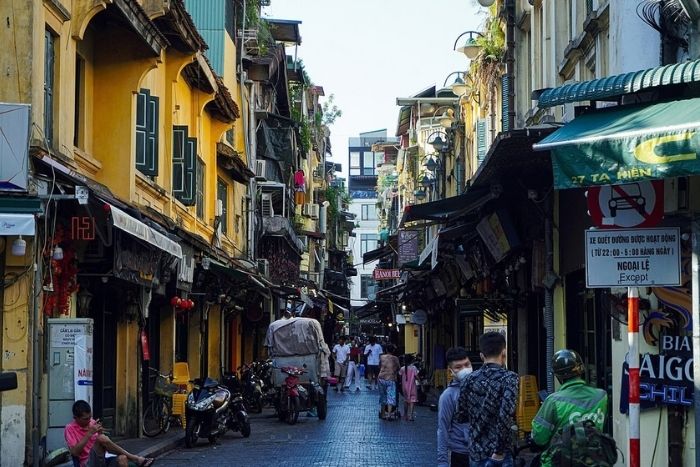
There is no single right way to the Hanoi walking tour. Some travelers are looking for iconic monuments, while others prefer markets, gastronomy or less crowded neighborhoods. Here are five routes that reveal very different sides of the capital.
For a first trip, this Hanoi walking tour is one of the easiest introductions to the city. Start at Hoan Kiem Lake, a true landmark in the heart of the capital. From the lakeside, you can see the Turtle Tower, while the red The Huc Bridge leads to Ngoc Son Temple.
From the lake, continue to St. Joseph’s Cathedral, completed at the end of the 19th century. The atmosphere changes quickly: the narrow streets of the city center gradually give way to the wider avenues of the French Quarter and their historic buildings.
You can extend the walk toward the Vietnam Women’s Museum and then the Hanoi Opera House. This route therefore combines Vietnamese heritage, French-influenced architecture, museums and everyday scenes without requiring long journeys between sites.
Choose it if: you are visiting Hanoi for the first time and want to see several sides of the capital within a few hours.
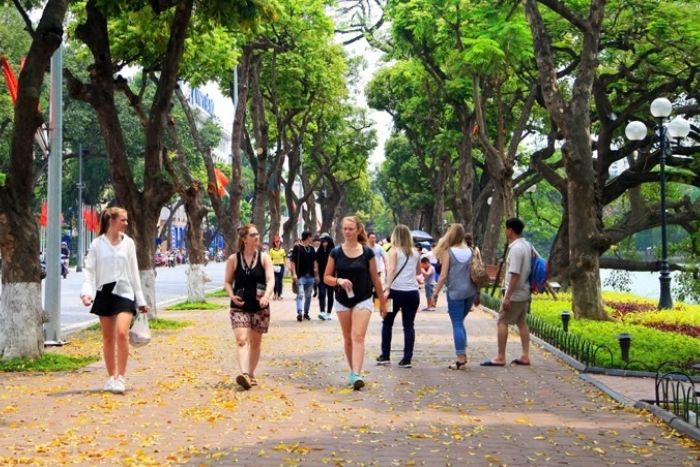
For a more popular and authentic atmosphere, set off from the Old Quarter toward Dong Xuan Market. Before leaving, stopping at a traditional café is a great way to start the day like a Hanoian. Around Hang Dao, Cau Dong and Hang Khoai Streets, shops, vendors and small restaurants create a particularly lively urban setting.
Continuing north, the route reaches the railway station and then Long Bien Bridge. From the section reserved for local traffic and pedestrians, the landscape gradually opens onto the Red River and the cultivated areas below.
The most curious walkers can continue toward the agricultural fields commonly known as “Banana Island.” The contrast with the densely built-up streets of the city center is striking: within a short time, the city gives way to farmland and a much quieter atmosphere.
This way of Hanoi walking tour is better suited to those who want to watch the city come alive rather than simply collect monuments.
Choose it if: you enjoy markets, street photography and urban contrasts.
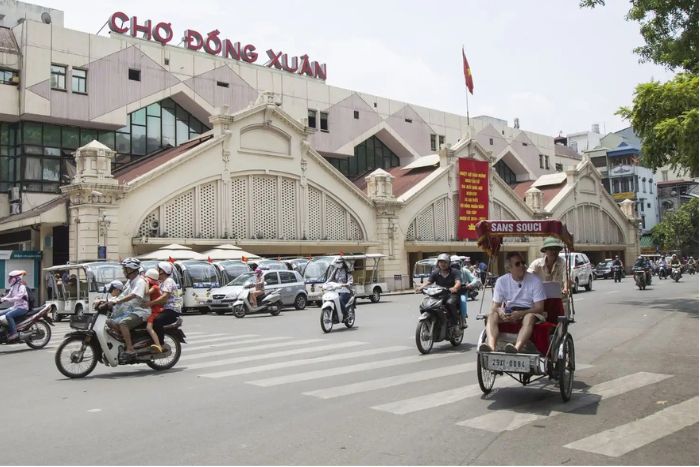
This Hanoi walking tour reveals a quieter and more historic side of the capital. The walk can begin on Phung Hung Street, known for its large murals depicting Hanoi as it once was. Continue to Phan Dinh Phung Street, where the atmosphere changes with a broad, tree-lined avenue surrounded by old buildings.
The route passes near the North Gate of the former citadel and Cua Bac Church before continuing toward Quan Thanh Temple. From there, Thanh Nien Street offers a unique walk between Truc Bach Lake and West Lake.
Finish around Truc Bach and Ngu Xa. This area provides an opportunity to slow down after the busy streets of the city center while easily combining heritage, lakeside scenery and a gourmet break.
Choose it if: you enjoy history and photogenic streets and want to alternate between monuments and quieter spaces.
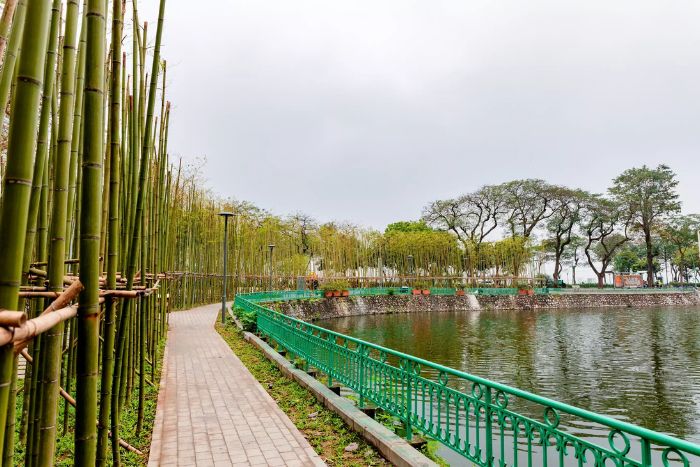
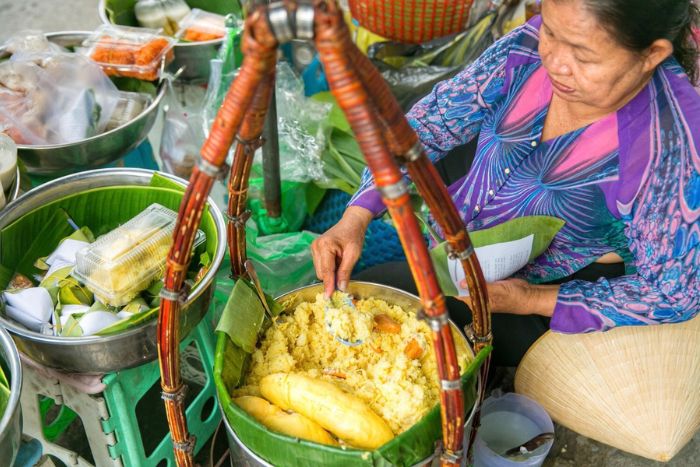
It is impossible to the Hanoi walking tour without noticing the importance of food in the urban landscape. Here, great places to eat are not limited to restaurants: some specialties are enjoyed on small plastic stools, in family-run food stalls or at the back of a narrow alley.
In the Old Quarter, build your route around a few food stops rather than a succession of monuments. Phở, bún chả, bánh mì and egg coffee can punctuate your walk. It is better to select three or four stops and walk between them so that you can truly enjoy the experience.
Another option is to finish in Ngu Xa, near Truc Bach Lake. The neighborhood is particularly known for phở cuốn, made with rolled rice noodle sheets, as well as phở chiên phồng, prepared with fried squares of rice noodles.
Choose it if: food is an essential part of your trip and you prefer to discover the capital through its flavors.
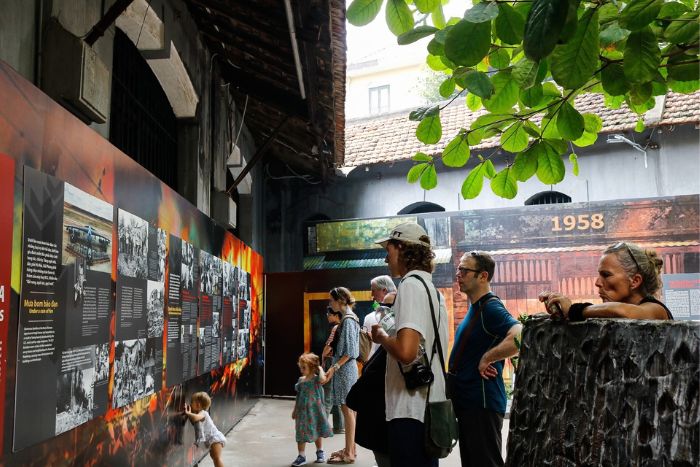
Travelers interested in history can dedicate another Hanoi walking tour to the area south of Hoan Kiem Lake. Hoa Lo Prison is an important stop for understanding several complex periods of contemporary Vietnamese history. Take the time to visit the site rather than treating it as simply a photo stop.
After the visit, continue toward the streets of the French Quarter. The architecture reveals another layer of Hanoi’s urban history, with administrative buildings, old villas and broad avenues laid out during the colonial period.
This route requires more time at the sites themselves and fewer kilometers on foot. It is therefore perfectly suited to a cultural half-day.
Choose it if: you want to give your walk a historical dimension and understand the city beyond its landscapes.
The best route depends above all on the time available and what you expect from the capital.
Itinerary | Ideal for | Main attractions |
Hoan Kiem & French Quarter | First-time visitors | Lake, cathedral, architecture, museums |
Old Quarter & Long Bien | Local life | Market, old streets, Red River |
Phung Hung & Truc Bach | Culture and photography | Murals, heritage, temples, lakes |
Food tour | Food lovers | Street food, cafés, local specialties |
Hoa Lo & French Quarter | History | Memory, architecture, urban history |
If you only have a morning, Hoan Kiem and the French Quarter offer a good overview of the city center. With more time, the route toward Long Bien provides an interesting contrast between the dense urban environment and the landscapes along the Red River. Photography enthusiasts will particularly enjoy Phan Dinh Phung and Truc Bach.
Finally, there is no need to combine everything. To explore the Hanoi walking tour without getting tired, it is better to dedicate several walks to different neighborhoods and leave room for unexpected detours.
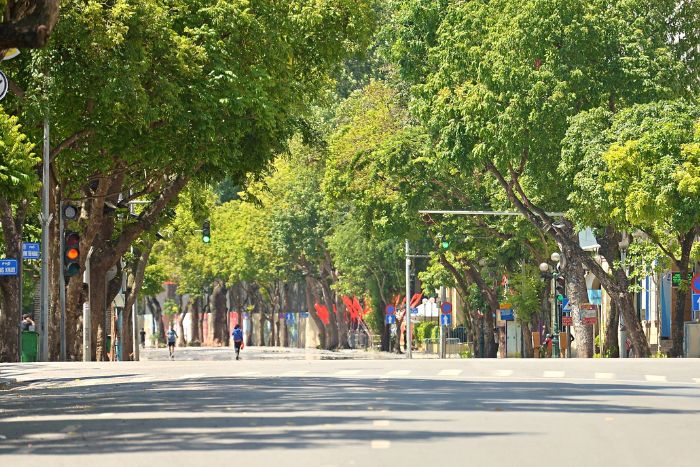
A successful walk starts with choosing the right time. During hot periods, set out early in the morning or in the late afternoon. Around Hoan Kiem Lake, the morning also allows you to observe local residents exercising before the streets become busier.
Bring comfortable shoes, water and allow time for regular breaks. Traffic can be surprising during a first Hanoi walking tour: cross carefully, keep your movements predictable and avoid rushing between vehicles.
In temples, pagodas and other religious sites, dress and behave respectfully. Also check museum opening hours before setting out, as an improvised walk becomes less enjoyable if the main site you planned to visit is closed.
Finally, do not overload your schedule. Two or three in-depth visits are often better than a long list of stops visited too quickly. If you are planning your entire trip, you can also learn more about the Vietnam travel budget to anticipate expenses for transportation, accommodation, meals and activities.
Ultimately, there is no single route for discovering the capital. A Hanoi walking tour around Hoan Kiem will appeal to first-time visitors, while Long Bien is ideal for travelers curious about more local scenes. Truc Bach is particularly attractive to heritage and photography enthusiasts, while a food-focused itinerary allows you to explore Hanoi through its specialties. The best approach is to explore Hanoi on foot without trying to tick off every attraction: take the time to stop in an alley, in front of a food stall or at a café. It is often between the well-known sights that the city becomes most captivating. To adapt these walks to the duration and pace of your trip, the Local travel agency in Hanoi - Autour Asia can help you create a personalized itinerary in Vietnam.
You can refer to:
> 4-day Da Lat Nha Trang trip










 FR
FR ITA
ITA