
Are you planning your first trip to Vietnam and wondering whether 14 days are enough to discover the country? The answer is yes, as long as you do not try to see everything. From the mountainous North to the Mekong Delta, Vietnam offers a great diversity of landscapes, cultures, and local specialties. However, the distances between regions mean that you need to choose your destinations carefully. To make the most of your stay, it is better to plan a well-organized itinerary rather than spend too much time traveling. Whether you are traveling as a couple, with children, or with friends, a Vietnam travel agency can also help you adapt the itinerary to your pace.
Indeed, 2 weeks in Vietnam is a good length for a first trip. In 14 days, you can explore several regions of the country, as long as you plan a coherent itinerary and avoid long detours.
How many days in Vietnam for a first trip? For a first visit, ideally plan 10 to 14 days. One week is already enough to focus on one region, but two weeks offer more possibilities without turning the trip into a succession of long journeys. You can then connect the North, Central Vietnam, and the South, while spending enough time at the main destinations.
For a first trip to Vietnam, a North-to-South itinerary is particularly easy to organize. Hanoi allows you to discover the capital, its Old Quarter, and its street food. Ninh Binh then offers a different setting, with rivers and limestone landscapes. Further south, Hoi An combines heritage, villages, and beaches, before ending in Ho Chi Minh City and the Mekong Delta.
However, is 2 weeks enough for Vietnam as a whole? No, and that is exactly why you need to make choices. The country stretches for more than 1,600 km from North to South, while some regions such as Ha Giang and Phong Nha deserve several days on their own. In 14 days, it is therefore better to explore a few destinations in depth rather than add too many stops. The regions you leave out can be saved for your next trip.

For a first trip to Vietnam 2 weeks, there is no need to try to travel across the whole country. Here is an example of a 14-day itinerary that allows you to discover the North, Central Vietnam, and the South while limiting long journeys:
Days 1-2: Hanoi - explore the Old Quarter, Hoan Kiem Lake, and the main areas of the capital.
Days 3-4: Ninh Binh - discover the karst landscapes, take a boat trip in Trang An, and explore the surroundings by bike.
Days 5-6: Lan Ha Bay - enjoy a two-day cruise with an overnight stay on board, water activities, and time to relax.
Days 7-9: Hoi An - explore the Old Town, surrounding villages, local cuisine, and enjoy some time at the beach.
Days 10-11: Ho Chi Minh City - discover the city, local markets, food, and nightlife.
Days 12-13: Mekong Delta - take a day trip or stay with a local family to discover the markets, canals, and rural life.
Day 14: Ho Chi Minh City - enjoy a free morning before your return flight.
This 14-day Vietnam itinerary can then be adapted to the travelers’ profile. For a 2 week family trip to Vietnam with kids, it is better to reduce hotel changes and allow more free time. On the other hand, 2 weeks in Vietnam with friends can include more active or unusual destinations, such as Ha Giang or Phong Nha, instead of some classic destinations.

How to organize 2 weeks in Vietnam without spending a large part of your trip on the road?
The first rule is not to try to see everything. Start by limiting the number of destinations. Spending two or three nights in the same place allows you to enjoy it more and avoid packing your bags every day. Likewise, try not to go back and forth between destinations.
For a first trip to Vietnam, traveling from North to Central and then South is particularly convenient. You can arrive in Hanoi and leave from Ho Chi Minh City, which avoids losing a day on a return flight to your starting point.
Domestic flights are useful for long distances, especially between Hanoi, Da Nang, and Ho Chi Minh City. For shorter journeys, trains, buses, or private transfers may be more suitable. Also, book your hotels, domestic flights, and key excursions in advance, especially cruises in the bay.
Your pace should also be adjusted according to the season. During hot or humid periods, plan more breaks and choose to visit places early in the morning. When traveling with children, having a few free hours during the day can make a real difference.
For a tailor-made itinerary, a local travel agency in Hanoi can also coordinate transportation, guides, and accommodation while taking your needs into account.

What should you prepare before your trip?
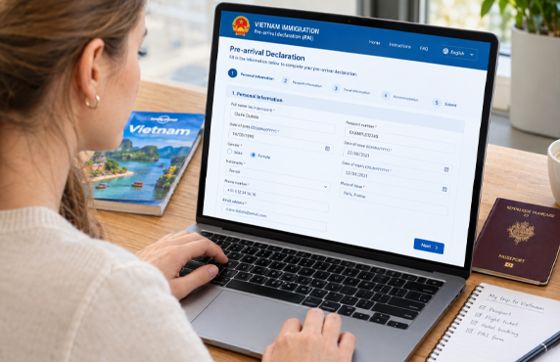
First, check the entry requirements and visa conditions for your nationality. Then, bring a bank card suitable for international payments, while keeping some cash in Vietnamese dong for small shops, markets, and transportation. For clothing, choose light and breathable outfits, with a light jacket for cooler evenings in the North. A comfortable pair of shoes, a light rain jacket, and sun protection will also be useful.
The cost of a trip mainly depends on accommodation, transportation, and excursions. The amounts below are an estimate per person for 14 days, excluding international flights. As a general guide, expect to pay around 25,000 to 60,000 VND ($1.05 to $2.55) for a street food dish, 150,000 to 400,000 VND ($6.40 to $17.40) for a simple room or guest house depending on the destination, and around 400,000 to 1,500,000 VND ($17.40 to $63.80) for some journeys or excursions.
This option is suitable for travelers who prioritize experiences over hotel comfort.
You can stay in hostels, guest houses, or simple rooms, eat mainly in small local restaurants, and use buses, trains, and apps such as Grab. Free activities, markets, and group excursions can also help keep costs down.
Domestic flights are still possible, but it is better to book them early to get good prices. For a 2 week in Vietnam on a budget, street food and local accommodation can significantly reduce your daily expenses.
This budget allows you to travel without always looking for the cheapest option. You can choose 3- or 4-star hotels or small boutique hotels, eat at good local restaurants, and take domestic flights to save time. For example, expect to pay around 100,000 to 250,000 VND ($3.85 to $9.65) per person at a good local restaurant. A short private car transfer can cost around 500,000 to 1,000,000 VND ($19 to $39), which can be shared when traveling with several people.
You can then include several excursions, for example in Ninh Binh, Lan Ha Bay, or the Mekong Delta, as well as occasional private transfers. A cooking class, a bike ride, or a guided excursion can also be added to the itinerary.
To estimate your budget for 2 weeks in Vietnam more accurately, consider adding daily expenses and more expensive activities separately.

At this level, the budget mainly increases with the quality of the hotels and private services. You can choose 4- or 5-star hotels and resorts, with rooms that can easily cost more than 2,000,000 VND (around $77) per night, and reach several million VND at the most luxurious properties.
Private transfers, a private French-speaking guide, and a premium cruise in Ha Long Bay or Lan Ha Bay can also be included in the trip. This type of travel mainly offers more flexibility, with adapted schedules, less waiting time, and a personalized itinerary.

In conclusion, for a first trip to Vietnam, two weeks offer a good overview of the country as long as you focus on the quality of your itinerary rather than the number of destinations. By choosing a few well-connected stops, you can discover lively cities, natural landscapes, varied cuisine, and different aspects of Vietnamese culture without spending too many hours traveling. The most important thing is to adapt your pace to your budget, the season, and your travel companions. For a personalized trip, a Vietnam travel agency can also help you create a well-organized itinerary with services adapted to your priorities.









 FR
FR ITA
ITA