
Wat Phra Ngam - Ancient Tree-root Archway Temple In Ayutthaya
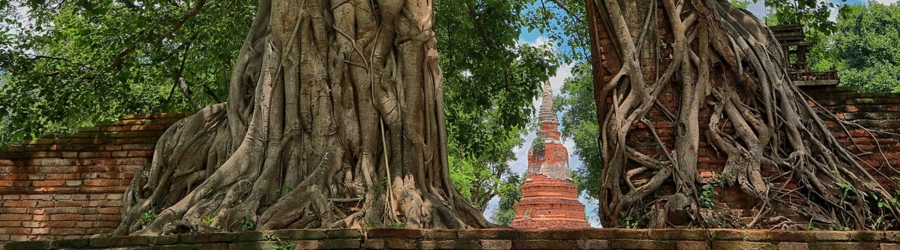
Just a few kilometres from the centre of Ayutthaya hides a site that very few foreign travellers bother to seek out, and that is precisely what makes it one of the most hauntingly beautiful places in the entire region. Wat Phra Ngam, nicknamed the "Portal of Time", is a ruined temple whose eastern gate has been slowly entwined, embraced, and ultimately absorbed by the sprawling roots of two sacred Bodhi trees. In this guide, we reveal everything you need to know to visit Wat Phra Ngam: its history, what you'll find there, and all the practical tips to plan your trip to Ayutthaya.
Wat Phra Ngam Ayutthaya
- 1. General information about Wat Phra Ngam
- 2. A brief history: the forgotten temple of King Narai
- 3. Portal of Time: when the Bodhi tree consumes stone
- 4. What to see at Wat Phra Ngam Ayutthaya ?
- 5. When and how to visit Wat Phra Ngam ?
- 6. How to get to Wat Phra Ngam ?
- 7. Practical tips for visiting Wat Phra Ngam
1. General information about Wat Phra Ngam
Thai name: วัดพระงาม
Alternative name: Wat Cha Ram (วัดชาราม)
Nickname: Portal of Time (Pratu Kala)
Type: Buddhist temple ruins
Religion: Theravada Buddhism
Location: Khlong Sa Bua, Phra Nakhon Si Ayutthaya District, Ayutthaya Province
Admission: Free
Opening hours: Open access (7:00 AM – 6:00 PM recommended)
Distance from the centre: ~3 km north of Wat Na Phra Meru
2. A brief history: the forgotten temple of King Narai
Wat Phra Ngam, which literally means "the temple of the beautiful Buddha", is also known by its older name, Wat Cha Ram. Its origins remain unclear, no historical records pinpoint an exact construction date, but archaeological excavations have revealed that its architecture follows the style of the early Ayutthaya period, dating to the late 14th and 15th centuries.
The first known written mention of the temple appears in stanza 23 of the Niras Nakhonsawan, a poem composed during the reign of King Narai (1656–1688). The temple was therefore already in existence at that time, and traces of several successive renovations suggest a long history of occupation. It appears that more recent pagodas were built over the original structures, pointing to continuous use across many centuries.
Like so many other temples in Ayutthaya, Wat Phra Ngam was most likely abandoned in 1767, following the second fall of Ayutthaya during the Burmese invasion that devastated the city. Since then, nature has reclaimed it — with unexpected grace.
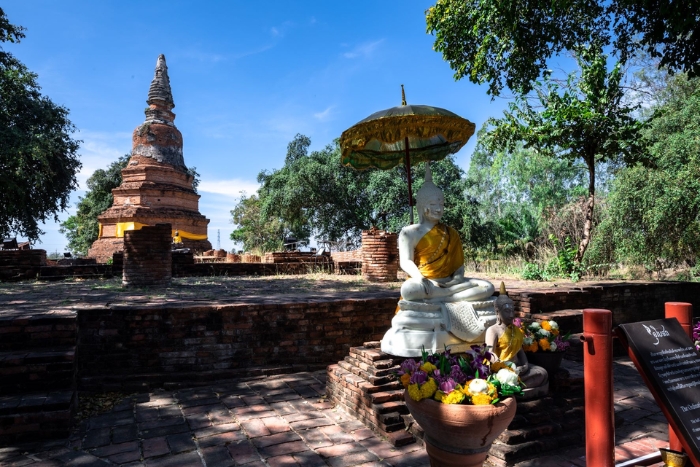
Excavations have unearthed remarkable artefacts: fragments of stucco and terracotta, roof tiles, metal objects, and sculpted motifs depicting Nagas and Hindu deities. Pre-Ayutthaya statues were also discovered, including crouching deer and clay Buddhas. Legend has it that the king of the era was so impressed by these clay sculptures that he chose to dedicate the temple to Buddha images. Some of these artefacts are now preserved at the Ayutthaya National Museum.
3. Portal of Time: when the Bodhi tree consumes stone
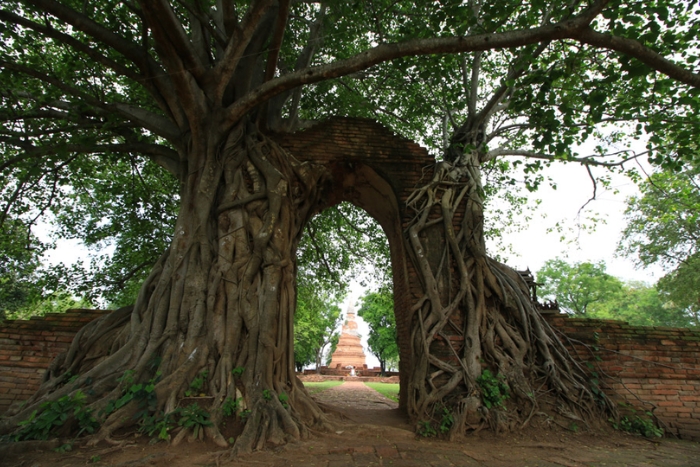
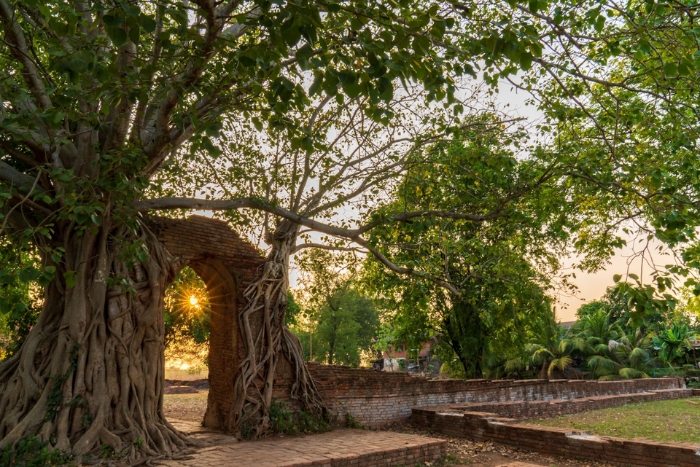
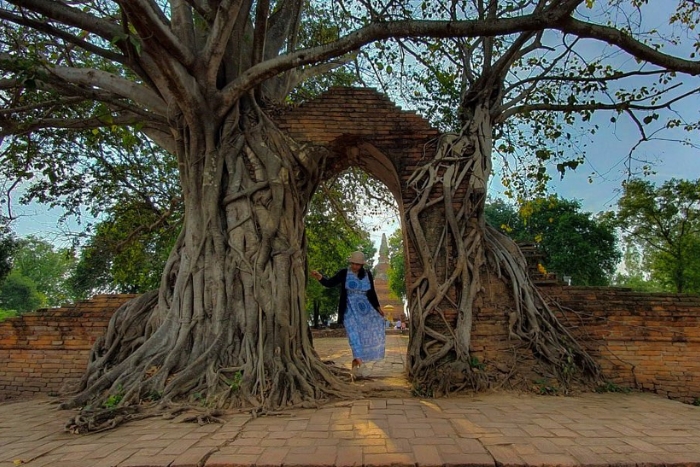
This is undoubtedly Wat Phra Ngam's most arresting sight: the temple's eastern gate, entirely engulfed by the roots of two towering Bodhi trees. Sacred in Buddhist tradition as the species under which the Buddha is said to have attained Enlightenment, these trees have patiently colonised the stonework over centuries. Their roots cascade down the archway like long grey fingers, creating a spectacular symbiosis between mineral and vegetable.
The Thais have named this spot Pratu Kala, the "Portal of Time", a reference to the way sunlight filters through the arch depending on the hour of the day. In the late afternoon, when golden rays pierce through the roots, the effect is truly magical.
On 11 April 2019, the Bodhi tree at Wat Phra Ngam was officially recognised by the Thai Ministry of Culture as one of the Rukkhaka Moradok, National Treasure Trees, a rare distinction that underscores the cultural and spiritual significance of this remarkable specimen.
4. What to see at Wat Phra Ngam Ayutthaya ?
Beyond the famous root-covered gate, the site holds a few pleasant surprises for those who take the time to explore it:
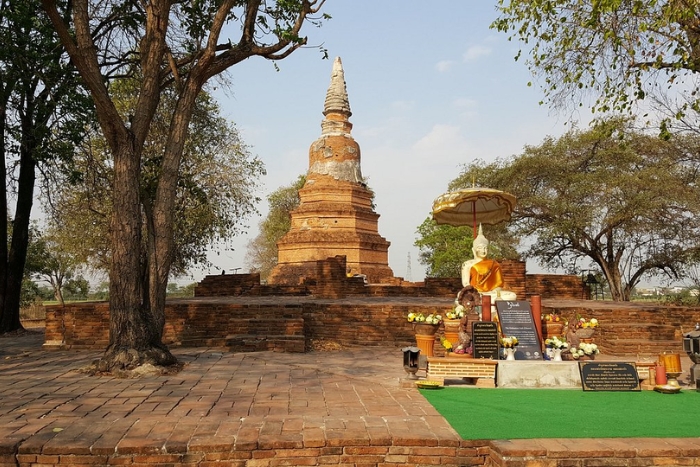
An octagonal chedi in relatively good condition, typical of early Ayutthaya architecture.
The foundations of the ubosot (ordination hall), with four entrances, two at the front, two at the rear.
A statue of Luang Pho (a venerable monk) in front of the base of the main hall.
Several satellite chedis scattered around the principal chedi.
A moat encircling the temple, providing a cool and shaded atmosphere even in the heat of the day.
The site is modest in scale, but that intimacy is precisely what makes it so endearing. Here, there are no crowds, no street vendors, no entrance ticket, just ruins, trees, and silence.
5. When and how to visit Wat Phra Ngam ?
The best time to visit Wat Phra Ngam is unquestionably late afternoon, during the golden hour. The low-angled light streaming through the arch of the Portal of Time at this hour makes for truly spectacular photography. The setting sun, which bathes the ruins in warm tones of ochre and amber, creates a serene and romantic atmosphere that early-morning visitors will simply never experience.
6. How to get to Wat Phra Ngam ?
Wat Phra Ngam is located in the Khlong Sa Bua sub-district, outside Ayutthaya's central island, roughly 3 kilometres north of Wat Na Phra Meru. It is not served by public transport, but several options are available:
By bicycle: The most enjoyable and most popular option among independent travellers. Bikes can be rented in town for around 50–80 THB per day. The road is flat and easy.
By tuk-tuk: Budget around 250 THB for a return trip, or more if you'd like to include other temples along the way. Always negotiate the price before setting off.
- By motorbike taxi: A quick option if you're travelling solo.
Important note: There is another temple named Wat Phra Ngam in Ayutthaya, located in the Ban Pom sub-district. That one is an active temple with resident monks. For the Portal of Time site, be sure to specify "Wat Phra Ngam Khlong Sa Bua" to your driver.
7. Practical tips for visiting Wat Phra Ngam
Combine your visit with Wat Na Phra Meru, located 3 kilometres away, for a full half-day off the beaten track.
Bring water: the site has no shops or vending machines nearby.
Respect the site: although the temple is in ruins, it remains a sacred Buddhist place. Keep a low profile, avoid touching the roots, and dress modestly.
Best season: November to February, during the dry season, to avoid oppressive heat and tropical downpours.
Wat Phra Ngam may not be Ayutthaya's grandest temple, nor the one most steeped in royal history. But it possesses something rare: a soul. Standing beneath the stone arch enveloped in roots, you feel the weight of centuries physically, that particular silence of places that have known both grandeur and ruin, and which nature has finally reclaimed with quiet, relentless patience. For travellers looking to venture beyond the standard itinerary and connect with something a little more authentic, a little more still, the Portal of Time in Ayutthaya is well worth the detour.
If you are planning a trip to Thailand and would like to visit Ayutthaya under the best possible conditions, the Autour Asia team, a travel agency in Asia, designs personalised itineraries tailored to your interests. Contact us to find out more.
>>> Ayutthaya 3-day itinerary
>>> Ayutthaya 5-day itinerary for couples
>>> Ayutthaya Travel Guide
>>> Thailand itinerary 2 weeks
>>> Thailand Tours
A visit to Wat Phra Ngam typically takes between 30 minutes and one hour. The site is modest in size, what remains is essentially the root-covered gate, an octagonal chedi, the foundations of the ubosot, and a few satellite chedis surrounded by a moat. This is not a temple you walk through quickly; it is rather a place where you linger, sit down, and observe. Photography enthusiasts will naturally spend more time here, especially during the golden hour. It pairs easily with a visit to the nearby Wat Na Phra Meru to make up a rewarding half-day off the beaten track.
The best time to visit Wat Phra Ngam is undoubtedly late afternoon, during the golden hour. Between 4:00 PM and 6:00 PM, the low-angled light of the setting sun streams through the arch of the Portal of Time and illuminates the Bodhi tree roots in shades of gold and amber, a truly unique spectacle that photographers in particular will appreciate. In terms of season, the dry season from November to February is ideal, as it allows you to avoid the oppressive heat and tropical rains. Since the site sees very little foreign tourist traffic, any time of day will offer a calm and peaceful visit.
A must-visit destination in any Thailand itinerary 2 weeks, Ayutthaya is an iconic stop located just an hour from Bangkok. Listed as a UNESCO World Heritage Site, this former royal capital reflects the power of the Siamese Kingdom between the 14th and 18th centuries. Visitors can explore the majestic remains of prangs (reliquary towers), Buddhist temples, and monumental monasteries that showcase the city’s past splendor. Today, Ayutthaya captivates travelers with its peaceful atmosphere, grand architecture, and the traces of a glorious era where spirituality and international trade coexisted in perfect harmony.
Related travel guide
Other similar articles


CUSTOMIZABLE BY LOCAL EXPERTS
Personalized trip at the original price!

REFUND GUARANTEE
We believe in our work and promise to give you money back.

GOOD PRICE / QUALITY
95% satisfied more than expected!

24/7 LOCAL SUPPORT
We are always available online to provide assistance at any time.

Most read articles


Autour Asia is highly recommended on
Embracing the mission of "Satisfied more than expected" and providing authentic experiences, we have received numerous recommendations on reputable travel forums: