
Eco-Farm Visit In Cambodia - A Guide For Sustainable Travel
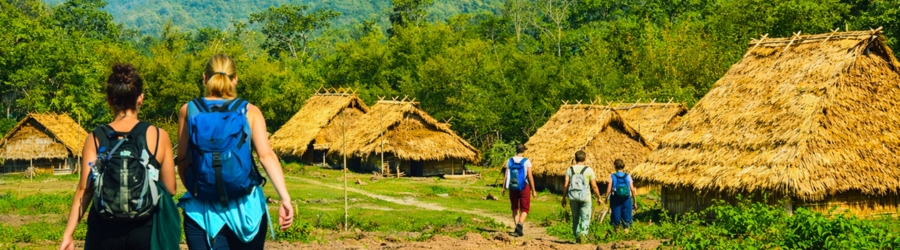
At a time when traveling is no longer limited to collecting photos, the eco-farm visit in Cambodia attracts those who are seeking a more authentic experience rooted in a true sustainable travel in Cambodia. Far from the classic itineraries, you discover a rural country where the land and agricultural work shape daily life. You may wonder how this immersion can truly enrich your stay. Between organic farming, traditional know-how and sincere encounters with local families, this interlude invites you to travel differently with more awareness and meaning. If you wish to integrate this type of experience into a coherent and personalized itinerary, the expertise of a local travel agency in Cambodia such as Autour Asia can help you design a responsible and harmonious stay.
Table of Contents
I. Why choose an eco-farm visit in Cambodia ?
Choosing an eco-farm visit in Cambodia means making the choice of a more authentic and more human journey. Rather than following only the classic circuits around Angkor Wat or the liveliness of Siem Reap, you head toward the countryside, where the landscape opens onto peaceful rice fields and rice paddies cultivated with patience. Little by little, the pace slows down and you begin to truly feel the country.
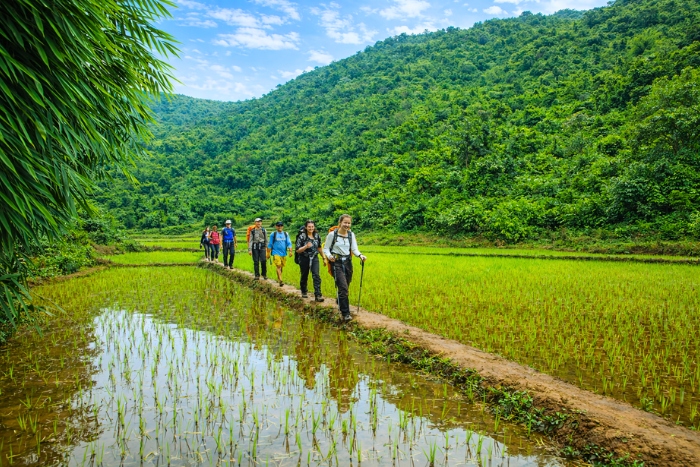
You no longer simply observe: you exchange with the farmers, you taste freshly harvested products, you discover where the rice and aromatic herbs on your plate come from. At the same time, your presence directly supports local families and encourages organic agriculture that respects the soil. Between November and March, under a soft light and a pleasant climate, the experience becomes even more precious. You leave with far more than memories: a sincere connection with the land and its inhabitants.
II. Where to visit an eco-farm in Cambodia ?
If you wish to experience a true rural immersion, several regions of Cambodia are particularly well suited to the discovery of farm stay in Cambodia. Each area offers a different atmosphere but all share the authenticity of the landscapes and the closeness to the inhabitants.
1. Eco-farm in Siem Reap: Between temples and local countryside

Living a true rural experience in Cambodia means discovering another side of Siem Reap, far beyond the mythical temples of Angkor Wat. Just a few kilometers away, the rice fields stretch under a soft light and the rice paddies tell the patient daily life of the farmers. Little by little, the pace slows down and you feel a more authentic atmosphere. Between November and March, the dry and pleasant climate makes the discovery even more comfortable. In this lively countryside, organic micro-farms develop pesticide-free market gardening, use natural compost and preserve traditional irrigation techniques adapted to the local climate. Some also perpetuate silk cultivation from mulberry to artisanal weaving. This immersion naturally fits into Cambodia eco tourism, respectful of the land and the communities.
Note: You can visit committed projects such as Angkor Silk Farm or Smiling Gecko Farmhouse, recognized for their sustainable and community-based approach.
2. Kampot and Kep: Discovering pepper and sustainable agriculture in the south
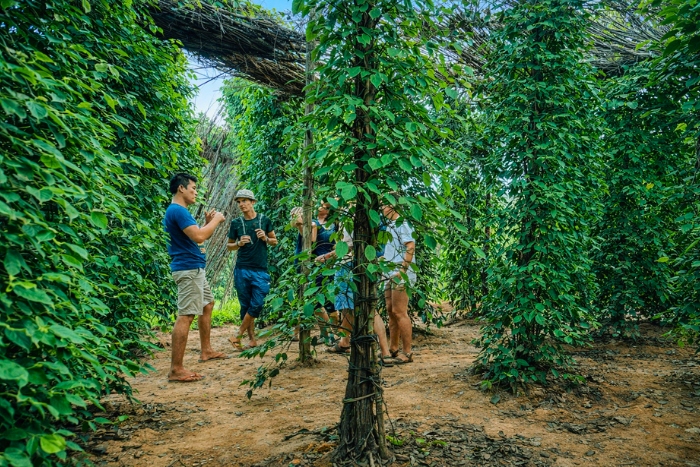
After the peaceful countryside of Siem Reap, you can continue your discovery toward the south, on the side of Kampot and Kep, where the landscape opens between mountains and sea. In the rural areas around Kampot, the famous pepper is cultivated on red lands rich in minerals, benefiting from a microclimate combining tropical heat and sea breeze which makes it a truly eco-friendly activity in Cambodia to better understand local agriculture. Recognized by a protected geographical indication, Kampot pepper is produced without chemical fertilizers, according to rigorous and sustainable methods. Nearby, the salt marshes sparkle under the sun. By choosing this region for your eco-farm visit in Cambodia, you discover a committed and deeply authentic terroir.
Note: Renowned farms such as La Plantation or Sothy's Pepper Farm perfectly illustrate the ecological excellence of the region.
3. Battambang: Immersion in the rural world and local farms
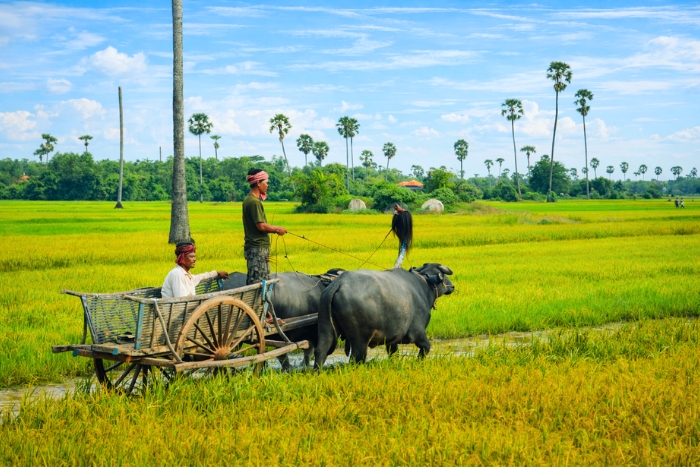
If, after Siem Reap and Kampot, you feel the desire for a Cambodia that is even more raw and deeply agricultural, head toward Battambang. Here, the landscape stretches as far as the eye can see in vast fertile plains where rice shapes the horizon and sets the rhythm of daily life, offering an ideal setting to discover an ecological farm in Cambodia as close as possible to rural realities. Nicknamed the rice bowl of Cambodia, the region lives to the tempo of the seasons: depending on the period, the fields shift from an intense green to a luminous golden yellow. Along the Sangker River, you observe an economy centered on Phka Rumduol jasmine rice and practices inspired by the eco-farm in Cambodia, favoring methods that respect the soil. Here, everything appears simpler and deeply rooted in the land.
Note: Several community projects around Phnom Sampeau and Ek Phnom develop responsible rural tourism centered on sustainable agriculture.
III. What to do in Cambodia during an eco-farm visit ?
An eco-farm visit in Cambodia is not limited to observing. On the contrary, you enter into a living, concrete and participatory experience. Each moment spent at the farm becomes an opportunity to learn, to feel and to understand the reality of the rural world.
1. Immersion in organic agricultural practices
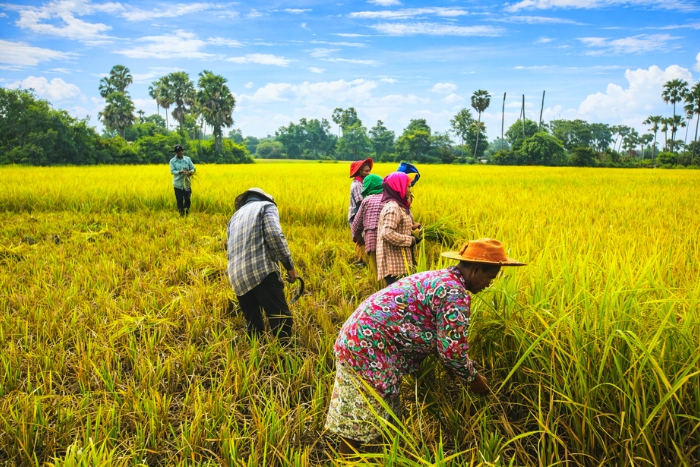
What makes this experience truly different is the moment when you cross the symbolic boundary between visit and participation. Within an eco-farm visit in Cambodia, you share the agricultural daily life, not as a spectator but as an actor, in the spirit of a true farm trip to Cambodia oriented toward immersion. Gradually, you enter the rice fields or the organic gardens, you learn to plant, harvest or water according to the season. Each gesture reveals an unsuspected precision. By preparing natural compost or taking part in the farm tasks, you understand how everything functions in balance, without chemical products. Little by little, work becomes understanding and it is in this closeness to the land that you feel the full human and authentic value of the experience.
2. Local flavors and garden cuisine
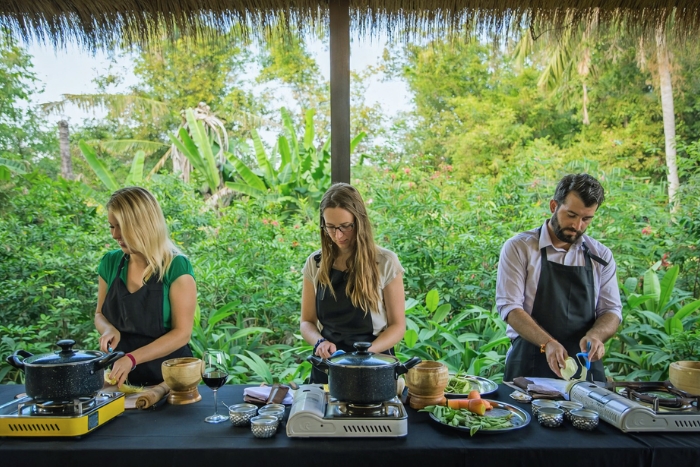
When the work in the fields comes to an end the experience naturally continues around the table. In an ecological farm in Cambodia, you discover that each dish tells the story of the land you have just touched, a typical immersion of an eco-farm in Cambodia committed to local and responsible production. Everything often begins with a walk in the vegetable garden: you pick aromatic herbs, ripe vegetables and fresh spices still bathed in sunlight. Then, in a kitchen open to a wood fire, you learn to prepare a few Cambodian specialties such as Amok or Lok Lak, by pounding the kroeung in a stone mortar. Little by little, the concept of “from garden to plate” takes on its full meaning and the shared meal becomes a warm, and deeply authentic moment.
3. Discovery of traditional gestures and Khmer know-how
Very often, it is in these calmer moments that the experience reveals all its depth. At the heart of ecological farms in Cambodia, you discover much more than a simple mode of production: you approach a true way of living, based on balance and transmission, in coherence with the spirit of sustainable travel in Cambodia. In the shade of a wooden shelter, conversations naturally take place around the seasons, the management of water and soil.

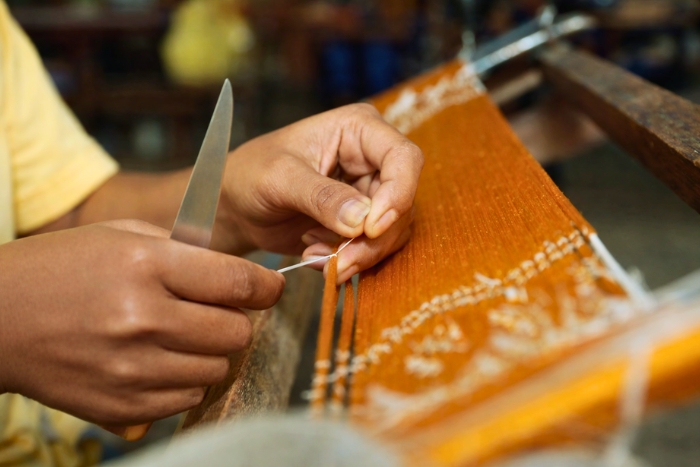
Then, you move from theory to practice by discovering the work of silk, from the breeding of silkworms to the delicate thread ready to be woven. You observe the precise gestures of traditional weaving, you initiate yourself into the first techniques of Khmer embroidery and also discover, more discreetly, the art of bamboo weaving passed down within the villages. Little by little, this immersion touches you deeply and leaves a lasting imprint on your perspective.
IV. Eco-farm and classic tourism: What difference ?
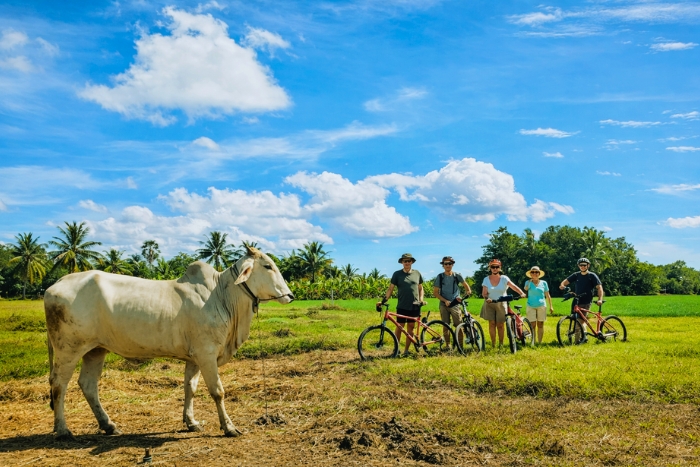
Choosing an eco-farm visit in Cambodia rather than a standard circuit does not only change your program: it transforms the overall impact of your stay. To help you concretely visualize this difference, here is a clear and structured comparison:
Aspect | Classic tourism | Eco-farm |
Economic impact | Revenues often captured by large agencies or international intermediaries. | Short circuit: your payment directly supports the family, organic seeds, the maintenance of rice fields and local education. |
Role of the traveler | Spectator: observation, photos, predefined program. | Actor: participation in activities, direct exchanges, contribution to the life of the farm. |
Pace of the stay | Tight planning, rapid succession of sites. | Slow travel: respect for the rhythm of the sun, the seasons and agricultural work. |
Ecological footprint | High consumption of plastic, intensive air conditioning, pressure on resources. | Waste management, solar energy, composting, active protection of biodiversity. |
Accommodation | Standardized hotels. | Rural guesthouses, ecolodges integrated into the landscape. |
Food | International buffets. | Garden cuisine, fresh “farm-to-table” products. |
Souvenirs | Industrial objects, often imported. | Local handicrafts made on site during workshops. |
In summary, the difference does not lie only in the activities offered, but in the philosophy of travel. In an ecological farm, you do not consume a destination: you become part of it, even briefly.
V. Practical advices for sustainable travel in Cambodia
Traveling in a responsible way does not require extraordinary efforts, but conscious choices. Here are concrete and easy-to-apply tips to make your stay more sustainable, especially if you choose an eco-farm visit in Cambodia.
- Choose local accommodations: Favor guesthouses, ecolodges or family farms rather than large international chains. Your money directly supports the local economy and rural families.
- Reduce your consumption of plastic: Bring a reusable bottle and refuse plastic bags or straws. In Cambodia, this waste is very widespread: every small gesture counts.
- Consume local and seasonal products: Opt for dishes prepared with seasonal products grown on site. This reduces the carbon footprint and allows you to discover true Khmer flavors.
- Save water and electricity: In rural areas, resources are limited. Limit air conditioning and long showers to respect the local environment.
- Favor gentle transport: When possible, choose cycling, walking or local transport to reduce emissions and live a more authentic experience.
- Respect local culture: Dress appropriately, ask before taking photos and adopt a respectful attitude. Sustainable tourism is also human and cultural.
Ultimately, choosing an eco-farm visit in Cambodia means deciding to slow down and to look at the country differently. Through encounters, agricultural gestures and know-how transmitted with simplicity, you understand that this immersion goes far beyond the framework of a one-time activity. It becomes a more conscious, more respectful and more connected way of traveling to the local reality. Building your itinerary around such an experience means favoring the quality of exchanges rather than the quantity of sites visited. If you wish to integrate this approach into your journey, the support of an agency expert in personalized travel in Cambodia such as Autour Asia can help you design a coherent stay, centered on the authenticity of a true eco-farm in Cambodia.
To organize a eco-farm visit in Cambodia with peace of mind and to experience an authentic immersion in an eco-farm, you can call on AUTOUR ASIA, a specialist in responsible stays in Cambodia, in order to benefit from a smooth, coherent itinerary that respects local communities as well as the environment.
You might be interested in:
- Farm stay in Vietnam
- 2-day agricultural tour in Cambodia
- Best places to visit in Cambodia in March for a sunny trip
- Cambodia Travel Guide
- 10-day Cambodia tour
- Cambodia Tours
The must-see highlights during a 10-day tour in Cambodia begin with the majestic Angkor Wat, the iconic UNESCO World Heritage temple complex that reflects the grandeur of the Khmer Empire. Within the Angkor Archaeological Park, travelers explore centuries of history before heading north to the 11th-century Preah Vihear Temple in the Dangrek Mountains. Natural wonders continue with the impressive Sopheakmit Waterfall, one of the largest in the region. For an immersive rural experience, the Somros Koh Han Community-Based Ecotourism site in the Mekong River Ramsar area offers biodiversity and authentic encounters. In Kratie, visitors can observe the rare Irrawaddy dolphin along the river, while Kampong Cham provides insight into local life and Buddhist traditions. The journey concludes in Phnom Penh, where historical landmarks reveal the complex heritage and enduring spirit of Cambodia.
A 2-day agricultural tour in Cambodia includes a progressive immersion into rural life around Siem Reap, combining the discovery of rice fields, meetings with farmers and sustainable craft workshops. The first day generally takes place in a village such as Chreav, with a visit to a local market, a Khmer cooking class using fresh ingredients, an ox-cart ride and an introduction to traditional rice cultivation techniques. The second day is dedicated to the Lotus Silk Farm, where you discover the complete process of lotus silk production, participate in eco-responsible creative workshops, and enjoy a boat ride in the heart of the lotus fields. The whole forms an authentic experience centered on community and sustainable tourism in Cambodia.
The ideal duration for an immersion in an eco-farm in Cambodia depends on your pace and your expectations but to fully enjoy the experience, a full day is generally recommended. A half-day allows a first discovery of agricultural activities and exchanges with local families, while a full day offers time to participate in fieldwork, share a meal prepared with organic products and better understand the organization of an eco-farm visit in Cambodia. For an even deeper immersion, spending a night on site allows you to experience rural daily life from sunrise to sunset, in the spirit of a true sustainable travel in Cambodia.
Related travel guide
Other similar articles


CUSTOMIZABLE BY LOCAL EXPERTS
Personalized trip at the original price!

REFUND GUARANTEE
We believe in our work and promise to give you money back.

GOOD PRICE / QUALITY
95% satisfied more than expected!

24/7 LOCAL SUPPORT
We are always available online to provide assistance at any time.

Most read articles


Autour Asia is highly recommended on
Embracing the mission of "Satisfied more than expected" and providing authentic experiences, we have received numerous recommendations on reputable travel forums: