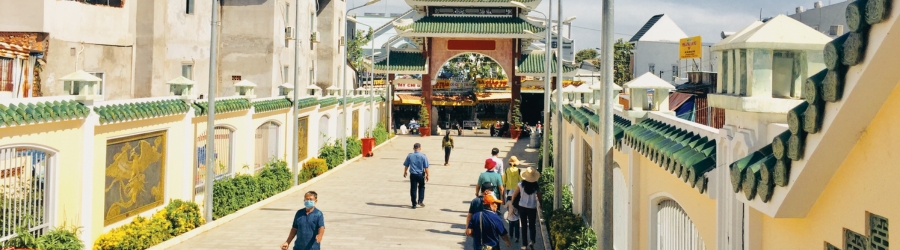
At the foot of Sam Mountain, in Vietnam's Mekong Delta, stands a sanctuary that draws millions of Vietnamese visitors every year, along with a growing number of foreign travelers curious to discover another side of the country. The Ba Chua Xu Temple at Sam Mountain is not just a monument to photograph: it is a living place of worship, steeped in legends and traditions passed down for two centuries. In this guide, we explain where to find the temple, why it fascinates so many people, how to get there from Ho Chi Minh City, and which rules to follow for a successful visit.
For generations, the temple of Ba Chua Xu (The Lady of the Realm) has been inseparable from the Chau Doc region, known for its mystical atmosphere. No rule requires it, but it has almost become a given: anyone visiting Chau Doc stops by the Lady Temple at Sam Mountain. Far more than a simple tourist site, this sanctuary is now a genuine source of pride for the city and for the entire An Giang province.
If you're leaving from Ho Chi Minh City, the easiest route is to take a long-distance bus via the Ho Chi Minh City - Trung Luong - My Thuan expressway, then continue on National Highway 91 to the center of Chau Doc. Expect around 207 km and just over five hours on the road; to save time, many travelers opt for an overnight bus.
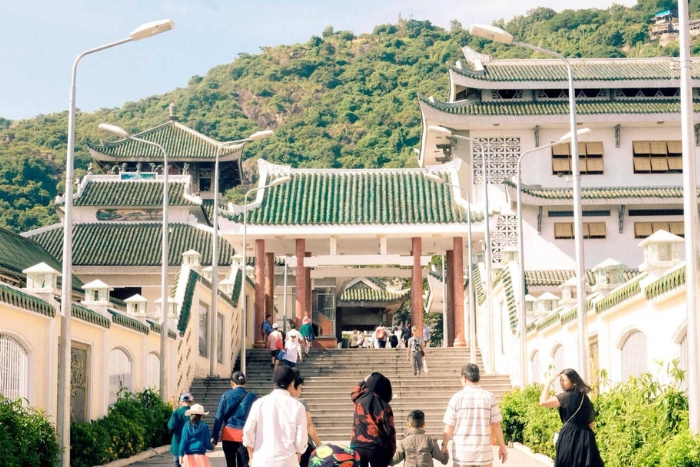
If you're already in Long Xuyen, a motorbike is a good option. Head first toward the Vinh Thanh Trung area, then follow National Highway 91 or provincial road DT945 to Kinh 4, in the Chau Phu B ward of Chau Doc. From there, take Chau Thi Te / Tan Lo Kieu Luong street, which leads directly to the foot of Sam Mountain. Along the way, you'll pass the Sam Mountain cable car tourist area, which is also worth a stop.
The temple can be visited year-round, but two periods are especially popular. The first is Tet, the Vietnamese Lunar New Year, when many locals come to pray for peace and serenity in the year ahead. The second is the major annual festival, held from the 24th to the 27th day of the 4th lunar month, with the largest crowds on the 25th, the central day of the ceremony. Depending on whether you're looking for a peaceful visit or full immersion in the festival atmosphere, choose your dates accordingly.
Ba Chua Xu (The Lady of the Realm) is known by several names, including Chua Xu Thanh Mau (Mother Goddess or Holy Mother of the Realm), Thanh Mau Chua Xu Nuong Nuong (Holy Mother or Goddess Nuong Nuong), and simply Nuong Nuong.
According to several studies, the statue of Ba Chua Xu on Sam Mountain in Chau Doc is believed to be the oldest sandstone statue in Vietnam; it also holds, according to the An Giang Province Book of Records (2009), the record for the largest number of ceremonial robes ever offered to it.
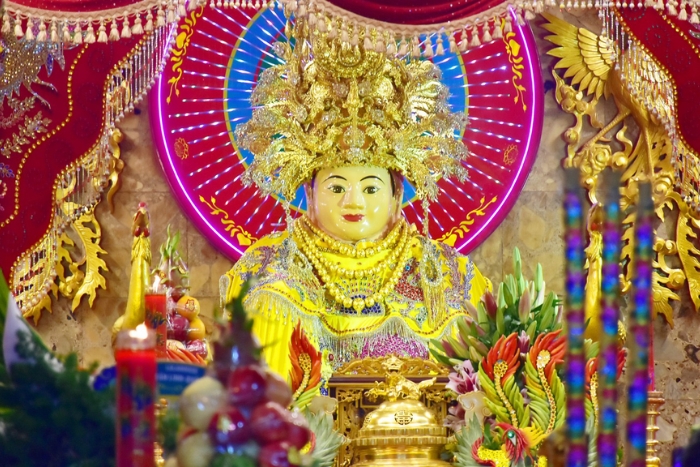
French archaeologist Louis Malleret, who studied the statue, believed it originally belonged to a group of representations of the god Vishnu, a male deity. According to his research, it has great artistic value and was likely carved at the end of the 6th century, most probably a relic of the Oc Eo civilization.
In the same vein, writer Son Nam suggested the statue was originally a male Khmer Buddhist statue, forgotten for a long time at the summit of Sam Mountain before being recovered and restored by local Vietnamese residents.
Another hypothesis, put forward by Tran Van Dung, author of History of the Settlement of the Chau Doc Region, 1757-1857, also argues that the Ba Chua Xu statue originally depicted a male figure seated in a royal posture. The current head is believed not to be original - it was reportedly recarved at a later date, using stone different from the rest of the body.
The temple's construction is believed to have originally been initiated by mandarin Thoai Ngoc Hau. At first, the sanctuary was a simple, modestly designed wooden structure. Later, grateful to Ba Chua Xu for favoring abundant harvests and protecting the village, local residents funded the construction of a sturdier, more refined temple in 1870.
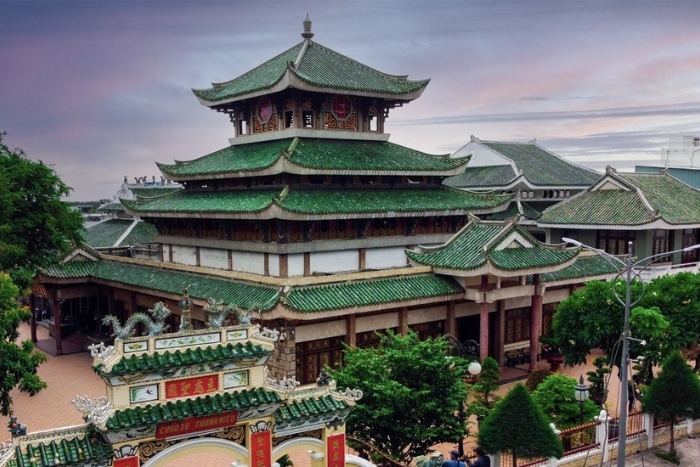
The temple's architecture reflects a strong artistic dimension. High up on the main building, statues of powerful, majestic deities appear to support the roof beams with their arms. The frames, doors, and other details are carved, engraved, and pierced with remarkable refinement.
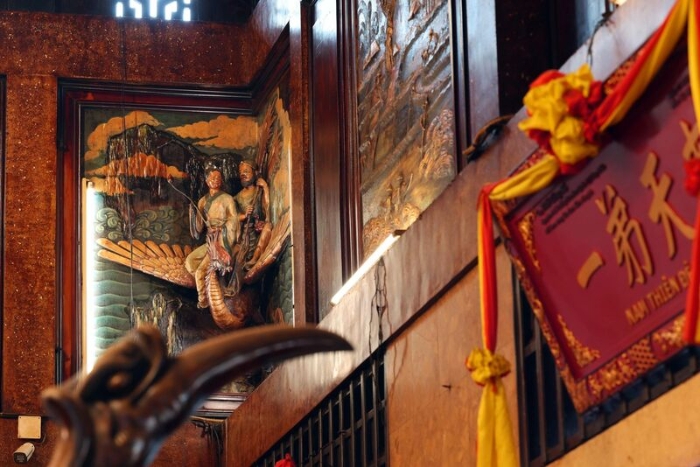
By 1976, the temple was nearly complete. Seen from above, its layout evokes the Sino-Vietnamese character "Quốc" (the nation), with roof volumes that unfold like a blooming lotus flower.
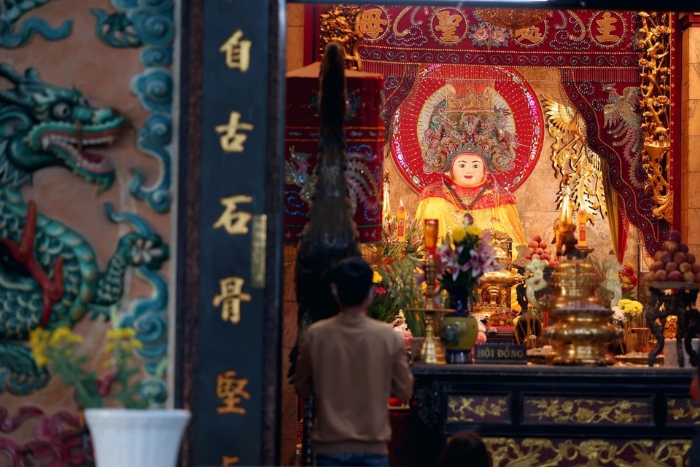
The main sanctuary consists of two levels. The inner level houses the actual worship space, with the goddess's statue placed on a raised pedestal; two white cranes stand beside her, symbolizing her immortal nature.
To the right of the statue is an altar bearing a stone linga, a male symbol, called the "Little Lord's Altar" (bàn thờ Cậu). On the other side stands an altar with a wooden carving representing a yoni, a female symbol, called the "Little Lady's Altar" (bàn thờ Cô).
The second level, near the two phoenix statues, houses the Council Altar (bàn thờ Hội đồng). On either side are the altars dedicated to the founding pioneers (Tiền hiền) on the left, and to their successors (Hậu hiền) on the right.
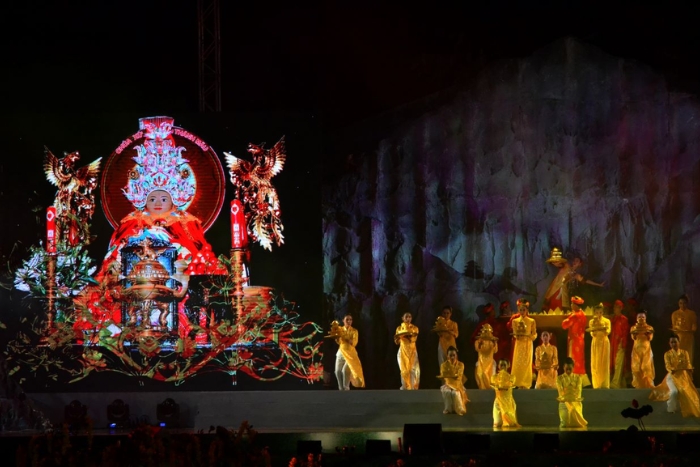
Each year, the Ba Chua Xu Festival at Sam Mountain becomes the center of a major popular celebration, the Ba Chua Xu Goddess Festival on Sam Mountain (Via Lady Festival), generally held in late April or early May according to the lunar calendar. Over several days, ritual ceremonies, processions, and folk performances draw crowds from across the Mekong Delta, as well as from the region's Khmer, Chinese, and Cham communities.
In December 2024, UNESCO inscribed this festival on the Representative List of the Intangible Cultural Heritage of Humanity, a recognition that underscores the tradition's importance for social cohesion and dialogue between the different communities of southern Vietnam. It's a rare distinction that places this event among the country's most significant cultural celebrations.
If you visit during this period, expect a unique atmosphere, but also considerable crowds: it's best to book accommodation in advance and allow for some patience in the queues.
When coming to pray at the Ba Chua Xu Temple at Sam Mountain, beyond preparing your offerings and your sincerity, here are a few rules to keep in mind:
What to avoid:
Don't wear overly revealing or inappropriate clothing: opt for modest, sober attire, avoiding shorts, tank tops, and fabrics that are too thin or too tight.
Don't use coarse language, argue, or joke loudly inside the temple. Speak softly, walk calmly, and avoid making noise, especially in the main sanctuary.
Never take the flowers, fruit, or small coins left on the altars.
Never touch the statue of Ba Chua Xu.
If you draw an oracle stick (xin xăm) and aren't satisfied with the result, avoid trying again repeatedly: local belief holds that this may reduce its effectiveness and cause confusion.
Never throw coins toward the statue, the incense burner, or the offering tray.
A few helpful tips for a successful visit:
Choose the right time: early morning or late afternoon are the most pleasant times to visit the Lady Temple at Sam Mountain. The space is less crowded then, making it easier both to pray and to take in the visit.
Pray with sincerity: the most important part of a temple visit remains sincerity of heart. Offerings and prayers should come from genuine, well-meaning intentions to be truly heard.
Watch your belongings: stay alert to your personal items and avoid carrying too much cash or valuables.
Don't give money to beggars near the site, so as not to encourage exploitation of popular beliefs for profit.
Limit purchases of "lộc" (lucky charms) and bird-release services: avoid buying lucky charms or paying to release birds, so as not to contribute to the commercialization of religious practice.
Stay calm, avoid pushing: this preserves the solemn character of the place and reduces the risk of pickpocketing in crowds.
The Ba Chua Xu Temple at Sam Mountain is more than just a tourist curiosity: it's a window into the beliefs, history, and community life of southern Vietnam. Between its fascinating legend, colorful architecture, and festival now recognized by UNESCO, this sanctuary deserves a place in any Mekong Delta itinerary.
To organize your custom craft trip 2 weeks in Vietnam, Autour Asia, travel agency in Saigon, accompanies you at every step of your journey.






 FR
FR ITA
ITA